
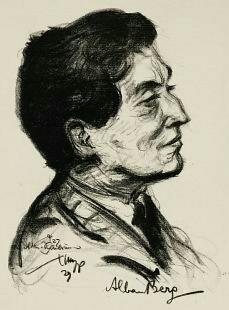
Komponist / Komponistin
Alban Berg
- 9. Februar 1885 – 24. Dezember 1935
Biografie
Alban Berg was one of the principal composers of the Second Viennese School. He grew up in a middle‑class home in Vienna and, as a youth, wrote more than a hundred songs and piano pieces before receiving formal training. In 1904 he met Arnold Schoenberg, who taught him for six years without charge and shaped his artistic personality. Berg’s early works – the Piano Sonata Op. 1, the Four Songs Op. 2 and the String Quartet Op. 3 – already point toward atonality and combine the influence of Gustav Mahler and Richard Wagner with a new chromatic language.
With his opera Wozzeck, after Georg Büchner, and the later unfinished Lulu, Berg fused the twelve‑tone technique with intense drama and created milestones of twentieth‑century music. He wrote slowly and carefully; major works include the Chamber Concerto and his final completed piece, the Violin Concerto (1935), dedicated “to the memory of an angel” in honour of Manon Gropius. Berg spent most of his life in Vienna, served in the War Ministry during World War I and died in 1935 from blood poisoning. His music is seen as a bridge between late Romanticism and serial modernism.